Mostrando entradas con la etiqueta REAL MANIPULATIVE AND HAND-MADE MATERIALS. Mostrar todas las entradas

jueves, 17 de marzo de 2022

THE FAIRY DOOR

By Laura Benito

This piece of wood is the Fairies door. It helps you to keep in touch with the fairies whenever you are worried because you have a problem... put the hand on it. The hand is red...

But fairies make your problems dissapear and the hand will become green! :D


This "tool" is also used in the Cornwall school I've mentioned before and it is a super idea!! I'm sure students will be fascinated.

I love it! What do you think about it?

You may also find it on Amazon (CLICK HERE)


THE WORRY MONSTER

By Laura Benito

I'm so excited about this amazing idea that I knew yesterday thanks to a colleague of CFP Idiomas who is in a school in Cornwall in Observa_acción Project.

It is called "The Worry Monster". 

It eats all the worries that children (and also teenagers and adults, why not?) give to it written on a piece of paper. There is one of these monsters in each class and children use it whenever they need.

You can buy this monster in Amazon (although maybe other online shops sell it). CLICK HERE


This is also another type of Worry Monster: (CLICK HERE)


miércoles, 16 de marzo de 2022

March Madness

By Óscar Javier Capilla

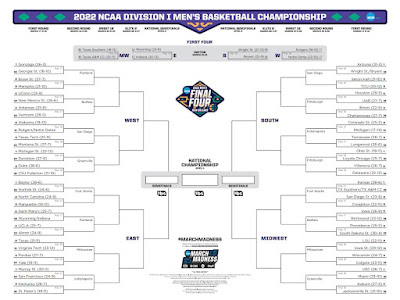
Every year the NCAA Men's Basketball tournament takes place during the month of March.  Students who follow NBA know that most draftees come from the sweet-sixteen teams.  I take advantage of this to make a pool with my class as to what team we think is going to win.

I used this as an cultural element of the English-speaking world so very marked by competition and sports.  At the same time they get to know some of the most important US universities where...who knows??? they might even study in the future.


https://drive.google.com/file/d/1T8oel9xOOl2fKU8nVkB7HkD1yLzjtS1q/view?usp=sharing


lunes, 14 de marzo de 2022

Story cubes

By Jara María Fernández, Arantzazu Fernández, Alba Paredes and Laura Benito.

I have just bought a box of story dices to practice past tenses. I have never used them before. I'm afraid some low-grade students could have some serious difficulties when trying to tell a story based on the cube's pictures on one hand, and some other students might experience a lack of imagination on the other. However, I will give a try.


In my case, as I´m a secondary school I think is a great idea to make them think and make up a story,maybe one day in which you do not want to use the book because they are tired.
It could be done as a speaking but afther that thet could write it or even make a comic.
I´ll get them!.


I usually use them in my Speaking classes. In advanced groups, they are told to write a story on their own and in low-level groups, I let them work in pairs.


Story cubes are very useful materials for encouraging students to talk or write stories.

And you can also make them. Here you have some webpages where you can print them for free:


By Yolanda Martínez.

You may also have story cubes online using this genially:

https://view.genial.ly/5bba214002bce40c952422a2/interactive-content-story-cubes


By Miriam Díaz

I share you some other Genial.ly in Spanish with dices, some of them you can edit and yo write in English.

I hope you like them


Answer buzzers

By Jara María Fernández


From time to time, I bring answer buzzers to my English classes. These buzzers, along with flahcards, which might be created by the teacher or even by students based on vocabulary and grammar issues are a perfect tool to play a game in teams of 4 students. 

martes, 1 de febrero de 2022

Using flyswatters in class

Por Belén Zamanillo

I use flyswatters in my English lessons to review vocabulary specially with the Preschool classroom and Primary 1 and 2. 

It is a very useful resource for me and my students enjoy using it a lot. They learn while playing.

We put the flashcards on the blackboard after reviewing them. Then in pairs I call a word and they have to run and swat it with the flyswatter. 


Por Laura Benito

Great as a TPR activity. I also use this object with my children in Infant levels and they love playing with them. For example, I divide them into two groups and I put some flashcards of a specific topic in the middle (for example clothes). In turns, they have to go running and hit the flashcard the teacher says with the flyswatter.


viernes, 3 de diciembre de 2021

Sounds box for reading stories

By Laura Benito

A motivating way for students to listen to a teacher reading a story or a book is the use of this sounds box.


While my colleague was reading a book to the students I was pushing the bottom of the corresponding sound. The story became alive and the children lived the story as if they were inside the book. 

Laughs sound, music sound, ideas sound, clapping hands sound... It is a fantastic device that you may find on different online shops. However, I bought mine in a physical shop called TIGER. It's cheap and I'm sure you would use it very often.


jueves, 2 de diciembre de 2021

Christmas advent calendar

By Laura Benito


The fist day of December I hang these advent calendar in the classroom.

Some days before December starts, I tell my students to bring papel rolls to class.


I use paper rolls (one for each day of December until 23rd) which i fill with lacasitos, gummies, small rubbers... small gifts for my students. I put inside the same number of elements than the students I have in the class. Then, I wrap each paper roll with long pieces of wool.

You can see it in this photograph.


I have a helper each day, so at the end of the English class or at the end of the morning before they go home (if I am the tutor of the class) he or she opens the paper roll of the corresponding day. Then, this super helper gives one "gift" for each classmate.

It's great to see their faces while the helper opens the paper roll of the day!


What's in the Christmas Present?

By Raquel Ortega


Taking advantage of the science lessons dealing with textures and the 5 senses, I'm going to try this activity on adjectives in my English class. It's a guessing game where students need to guess 12 presents just by giving them a descriptive adjective: light, heavy, soft, hard, ...

The idea is to have the 12 presents in realia inside 12 different boxes, so that kids can touch, feel, smell, etc beforehand. Once they get familiar with the objects, the students are given 12 different cards with a drawing of the presents. With the help of the descriptive adjectives in the cards, they need to guess what the present is. 


I think it's going to be fun!

I attatch the file I took from Teacherspayteachers, It's a free one, so you can download it if you have an account.

https://www.teacherspayteachers.com/Product/Interactive-Book-for-Christmas-Descriptive-Language-WH-Questions-5075891


Creative classes in the playground

By Miriam Escalante


I teach English at the first level of Enfant Education. I've used these ideas to reinforce colours: yes, at the playground!_as you can see at the photo_after their creation with buckets:


I've also used sand from the playground (they took it some days before) to introduce the vocabulary of shapes: circle. 

I think that when they have a creative experience, they learn more and more.


Road Dahl's "The Twits"

By César Martín Pisonero


In our 1st year of bilingual Compulsory Education, our students read Roal Dahl's "The Twits".

The main characters in this book are everything but neat people, so at the end of the year we prepare two activities:


1- They need to think of a disgusting recipe that only Mr and Mrs Twit would attempt to taste. Then, they take it down on a paper and they work in art class so as to produce it with art craft materials.

You can see an example here:


2- After having dealt with persuasive language, they need to produce a radio advert in order to convince potential buyers that these meals are the most appealing ever and that they really are missing out on a must-eat if they do not purchase them

Once all of this has been done, we exhibit their handcrafted recipes with a QR code that takes us to SOUND CLOUD, where listeners can access the adverts.


Flashcards to support teaching "The Very Hungry Caterpillar"

 By Elena de la Puente


What is it? 

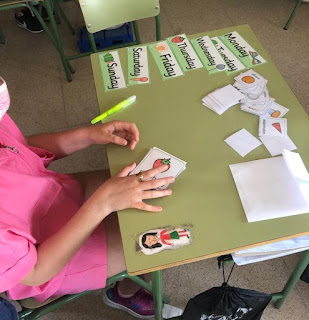
MANIPULATIVE MATERIAL: Flashcards to support teaching "The Very Hungry Caterpillar". 


What do you use it for? 

I use it for working the vocabulary that appears in the story. 

After reading the story, students can put the days of the week in order according to the story. Afterwards, we could classify the healthy food and the unhealthy food. You can also work the spelling of the food through games like the snap, the hang man, what's missing...